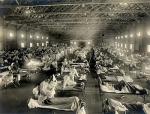
Very much this.
NYC being ground zero means the spread i starting from a major transit hub.
The only up side is that WHO and governments are meant to be planning for a pandemic. It is common already for customs to have cameras scanning arrivals for body temperature (I think) associated with a flu infection. I don't think these containment procedures would be up for a weaponized pandemic. Only cessation of air travel. And the time it takes for other governments to realize this, the virus will have already spread by then.
Birds,rodents, & insects are the biggest carriers of disease in world next to humans. The 1918 influenza pandemic (January 1918 – December 1920) Spanish flu From Wikipedia: https://en.wikipedia.org/wiki/Spanish_flu
The
1918 influenza pandemic (January 1918 – December 1920;
colloquially known as
Spanish flu) was an unusually deadly
influenza pandemic, the first of the two
pandemics involving
H1N1 influenza virus.
[1] It infected 500 million people around the world,
[2] including people on remote
Pacific islands and in the
Arctic, and resulted in the deaths of 50 to 100 million (three to five percent of the world's population),
[3] making it one of the deadliest natural disasters in
human history.
[4][5][6]
Infectious disease already limited
life expectancy in the early
20th century. But in the first year of the pandemic, life expectancy in the United States dropped by about 12 years.
[7][8][9] Most influenza outbreaks have a U-shaped mortality rate, disproportionately killing the very young and the very old, with higher survival rate for those inbetween, but the 1918 pandemic had a W-shaped mortality rate, with a higher than expected mortality rate for young adults.
[10]
To maintain morale,
wartime censors minimized early reports of illness and mortality in Germany, the United Kingdom, France, and the United States.
[11][12] Papers were free to report the epidemic's effects in neutral Spain (such as the grave illness of
King Alfonso XIII).
[13] This created a false impression of Spain as especially hard hit,
[14] thereby giving rise to the pandemic's nickname, "Spanish flu".
[15]
Scientists offer several possible explanations for the high mortality rate of the 1918 influenza pandemic. Some research suggests that the specific variant of the
virus was unusually aggressive. One group of researchers recovered the virus from the bodies of frozen victims, and
transfected animals with it, causing a rapidly progressive
respiratory failure and death through a
cytokine storm (overreaction of the body's
immune system). It was postulated that the strong immune reactions of young adults ravaged the body, whereas the weaker immune systems of children and middle-aged adults resulted in fewer deaths among those groups.
[16]
In 2007, analysis of medical journals from the period of the pandemic
[17][18] found that the viral infection itself was not more aggressive than any previous influenza, but that the special circumstances of the epidemic (malnourishment, overcrowded medical camps and hospitals, poor hygiene) promoted bacterial superinfection that killed most of the victims, typically after a somewhat prolonged death bed.
[19][20]
Historical and
epidemiological data are inadequate to identify the pandemic's geographic origin.
[2] It was implicated in the outbreak of
encephalitis lethargica in the 1920s.
[21]
Contents
[*]
2 Mortality
[*]
3 Legacy
[*]
4 Spanish flu research
[*]
5 Gallery
[*]
6 See also
[*]
7 References
[*]
8 Further reading
[*]
9 External links
History
Hypotheses about the source
The major troop staging and hospital camp in
Étaples, France, was identified as being at the center of the Spanish flu by research published in 1999 by a British team, led by
virologist John Oxford.
[22] In late 1917, military pathologists reported the onset of a new disease with high mortality that they later recognized as the flu. The overcrowded camp and hospital — which treated thousands of victims of chemical attacks and other casualties of war — was an ideal site for the spreading of a respiratory virus; 100,000 soldiers were in transit every day. It also was home to a live piggery, and poultry were regularly brought in for food supplies from surrounding villages. Oxford and his team postulated that a significant precursor virus, harbored in birds, mutated so it could migrate to pigs that were kept near the front.
[23][24]
An interesting speculation about the outbreak was made by Private Arthur Bullock in his World War I memoir, describing an incident in June 1918 when members of the Gloucestershire Regiment caught an intense fever after sleeping in a cowshed. Arthur also records how he evaded the flu despite being treated in a military hospital where everyone else had it.
[25]
In 2018,
Michael Worobey, an evolutionary biology professor at Arizona University who is examining the history of the 1918 pandemic, revealed that he obtained tissue slides created by
William Rolland, a physician who reported on a respiratory illness likely to be the virus while a pathologist in the British military during World War I.
[26] Rolland had authored an article in the Lancet during 1917 about a respiratory illness outbreak beginning in 1916 in
Étaples, France.
[27] Worobey traced recent references to that article to family members who had retained slides that Rolland had prepared during that time. Worobey is planning to extract tissue from the slides that may reveal more about the origin of the pathogen.
Nevertheless, there have been persistent claims that the epidemic originated in the United States. Historian
Alfred W. Crosby claimed that the flu originated in
Kansas,
[28] and popular author
John Barry described
Haskell County, Kansas, as the point of origin.
[29] It has also been claimed that, by late 1917, there had already been a first wave of the epidemic in at least 14 US military camps.
[30]
Earlier hypotheses put forward varying points of origin for the epidemic. Some hypothesized that the flu originated in East Asia, a common area for transmission of disease from animals to humans because of dense living conditions.
[31] Claude Hannoun, the leading expert on the 1918 flu for the
Pasteur Institute, asserted the former virus was likely to have come from China, mutating in the United States near
Boston and spreading to
Brest, France, Europe's battlefields, Europe, and the world via Allied soldiers and sailors as the main spreaders.
[32] He considered several other hypotheses of origin, such as Spain,
Kansas (United States), and Brest, as being possible, but not likely.
Political scientist
Andrew Price-Smith published data from the
Austrian archives suggesting the influenza had earlier origins, beginning in Austria in early 1917.
[33]
In 2014, historian Mark Humphries of the
Memorial University of Newfoundland in
St. John's stated that newly unearthed records confirmed that one of the side stories of the war, the mobilization of 96,000
Chinese laborers to work behind the British and French lines on World War I's western front, might have been the source of the pandemic. In the report, Humphries found archival evidence that a respiratory illness that struck northern China in November 1917 was identified a year later by Chinese health officials as identical to the "Spanish" flu.
[34][35] A report published in 2016 in the Journal of the
Chinese Medical Association found no evidence that the 1918 virus was imported to Europe via Chinese and Southeast Asian soldiers and workers. It found evidence that the virus had been circulating in the European armies for months and possibly years before the 1918 pandemic.
[36]
Spread
When an infected person sneezes or coughs, more than half a million virus particles can be spread to those close by.
[37] The close quarters and massive troop movements of
World War I hastened the pandemic, and probably both increased transmission and augmented mutation; the war may also have increased the lethality of the virus. Some speculate the soldiers' immune systems were weakened by malnourishment, as well as the stresses of combat and chemical attacks, increasing their susceptibility.
[38]
A large factor in the worldwide occurrence of this flu was increased travel. Modern transportation systems made it easier for soldiers, sailors, and civilian travelers to spread the disease.
[39]
In the United States, the disease was first observed in
Haskell County, Kansas, in January 1918, prompting local doctor Loring Miner to warn the U.S. Public Health Service's academic journal. On 4 March 1918, company cook Albert Gitchell reported sick at
Fort Riley, an American military facility that at the time was training American troops during World War I, making him the first recorded victim of the flu.
[40][41] Within days, 522 men at the camp had reported sick.
[42] By 11 March 1918, the virus had reached
Queens, New York.
[43] Failure to take preventive measures in March/April was later criticised.
[5]
In August 1918, a more virulent strain appeared simultaneously in
Brest, France; in
Freetown, Sierra Leone; and in the U.S. in
Boston, Massachusetts. The Spanish flu also spread through Ireland, carried there by returning Irish soldiers. The
Allies of World War I came to call it the Spanish flu, primarily because the pandemic received greater press attention after it moved from France to Spain in November 1918. Spain was not involved in the war and had not imposed wartime
censorship.
[44]
Mortality
Around the globe

The difference between the influenza mortality age-distributions of the 1918 epidemic and normal epidemics – deaths per 100,000 persons in each age group, United States, for the interpandemic years 1911–1917 (dashed line) and the pandemic year 1918 (solid line)
[45]
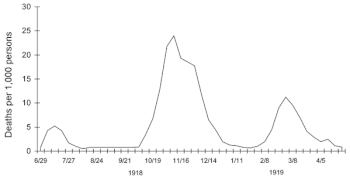
Three pandemic waves: weekly combined influenza and pneumonia mortality, United Kingdom, 1918–1919
[46]
The global
mortality rate from the 1918/1919 pandemic is not known, but an estimated 10% to 20% of those who were infected died. With about a third of the world population infected, this
case-fatality ratio means 3% to 6% of the entire global population died.
[2] Influenza may have killed as many as 25 million people in its first 25 weeks. Older estimates say it killed 40–50 million people,
[4] while current estimates say 50–100 million people worldwide were killed.
[47]
This
pandemic has been described as "the greatest medical holocaust in history" and may have killed more people than the
Black Death.
[48] It is said that this flu killed more people in 24 weeks than AIDS killed in 24 years, and more in a year than the Black Death killed in a century,
[16] although the Black Death killed a much higher percentage of the world's smaller population at the time.[49]
The disease killed in every area of the globe. As many as 17 million people died in India, about 5% of the population.
[50] The death toll in
India's British-ruled districts alone was 13.88 million.
[51]
In Japan, of the 23 million people who were affected, 390,000 died.
[52] In the
Dutch East Indies (now
Indonesia), 1.5 million were assumed to have died among 30 million inhabitants.
[53] In
Tahiti 13% of the population died during one month. Similarly, in
Samoa 22% of the population of 38,000 died within two months.
[54]
In
Iran, the mortality was very high: according to an estimate, between 902,400 and 2,431,000, or 8.0% to 21.7% of the total population died.
[55]
In the U.S., about 28% of the population became infected, and 500,000 to 675,000 died.
[56] Native American tribes were particularly hard hit. In the
Four Corners area alone, 3,293 deaths were registered among Native Americans.
[57] Entire
Inuit and
Alaskan Native village communities died in
Alaska.
[58] In Canada 50,000 died.
[59] In Brazil, 300,000 died, including president
Rodrigues Alves.
[60] In Britain, as many as 250,000 died; in France, more than 400,000.
[61] In West Africa the influenza epidemic killed at least 100,000 people in
Ghana.
[62] Tafari Makonnen (the future
Haile Selassie, Emperor of Ethiopia) was one of the first
Ethiopians who contracted influenza but survived.
[63][64] Many of his subjects did not; estimates for fatalities in the capital city,
Addis Ababa, range from 5,000 to 10,000, or higher.
[65] In
British Somaliland, one official estimated that 7% of the native population died.
[66]
This huge death toll was caused by an extremely high infection rate of up to 50% and the extreme severity of the symptoms, suspected to be caused by
cytokine storms.
[4] Symptoms in 1918 were so unusual that initially influenza was misdiagnosed as
dengue,
cholera, or
typhoid. One observer wrote, "One of the most striking of the complications was hemorrhage from mucous membranes, especially from the nose, stomach, and intestine. Bleeding from the ears and
petechial hemorrhages in the skin also occurred".
[47] The majority of deaths were from
bacterial pneumonia,
[67][68] a common
secondary infection associated with influenza. The virus also killed people directly, by causing massive
hemorrhages and
edema in the lung.
[68]
The unusually severe disease killed up to 20% of those infected, as opposed to the usual flu epidemic
mortality rate of 0.1%.
[2][47]
Patterns of fatality
The pandemic mostly killed young adults. In 1918–1919, 99% of pandemic influenza deaths in the U.S. occurred in people under 65, and nearly half in young adults 20 to 40 years old. In 1920, the mortality rate among people under 65 had decreased sixfold to half the mortality rate of people over 65, but still 92% of deaths occurred in people under 65.
[69] This is unusual, since influenza is normally most deadly to weak individuals, such as
infants (under age two), the very old (over age 70), and the
immunocompromised. In 1918, older adults may have had partial protection caused by exposure to the
1889–1890 flu pandemic, known as the Russian flu.
[70] According to historian John M. Barry, the most vulnerable of all – "those most likely, of the most likely", to die – were pregnant women. He reported that in thirteen studies of hospitalized women in the pandemic, the death rate ranged from 23% to 71%.
[71] Of the pregnant women who survived childbirth, over one-quarter (26%) lost the child.
[72]
Another oddity was that the outbreak was widespread in the summer and autumn (in the
Northern Hemisphere); influenza is usually worse in winter.
[73]
Modern analysis has shown the virus to be particularly deadly because it triggers a
cytokine storm, which ravages the stronger immune system of young adults.
[29]
In fast-progressing cases, mortality was primarily from
pneumonia, by virus-induced pulmonary
consolidation. Slower-progressing cases featured secondary bacterial pneumonias, and there may have been
neural involvement that led to
mental disorders in some cases. Some deaths resulted from malnourishment.
A study – conducted by He et al. – used a mechanistic modelling approach to study the three waves of the 1918 influenza pandemic. They tried to study the factors that underlie variability in temporal patterns, and the patterns of mortality and morbidity. Their analysis suggests that temporal variations in transmission rate provide the best explanation, and the variation in transmission required to generate these three waves is within biologically plausible values.
[74]
Another study by He et al. used a simple epidemic model, to incorporate three factors, including school opening and closing, temperature changes over the course of the outbreak, and human behavioral changes in response to the outbreak, to infer the cause of the three waves of the 1918 influenza pandemic. Their modelling results showed that all three factors are important but human behavioral responses showed the largest effects.
[75]
Deadly second wave
 American Expeditionary Force
 victims of the Spanish flu at U.S. Army Camp Hospital no. 45 in
Aix-les-Bains, France, in 1918
The second wave of the 1918 pandemic was much deadlier than the first. The first wave had resembled typical flu epidemics; those most at risk were the sick and elderly, while younger, healthier people recovered easily. But by August, when the second wave began in France, Sierra Leone, and the United States,
[76] the virus had
mutated to a much deadlier form. As the
PBS American Experience: Influenza 1918 episode says, October 1918 was the deadliest month of the whole pandemic.[
citation needed]
This increased severity has been attributed to the circumstances of the First World War.
[77] In civilian life, natural selection favors a mild strain. Those who get very ill stay home, and those mildly ill continue with their lives, preferentially spreading the mild strain. In the trenches, natural selection was reversed. Soldiers with a mild strain stayed where they were, while the severely ill were sent on crowded trains to crowded field hospitals, spreading the deadlier virus. The second wave began and the flu quickly spread around the world again. Consequently, during modern pandemics, health officials pay attention when the virus reaches places with social upheaval (looking for deadlier strains of the virus).
[78]
The fact that most of those who recovered from first-wave infections had become
immune showed that it must have been the same strain of flu. This was most dramatically illustrated in
Copenhagen, which escaped with a combined mortality rate of just 0.29% (0.02% in the first wave and 0.27% in the second wave) because of exposure to the less-lethal first wave.
[79] For the rest of the population, the second wave was far more deadly; the most vulnerable people were those like the soldiers in the trenches – young previously healthy adults.
[80]